Origins of the Lodge at Haughfoot Lodge in the Scottish Borders |
||||
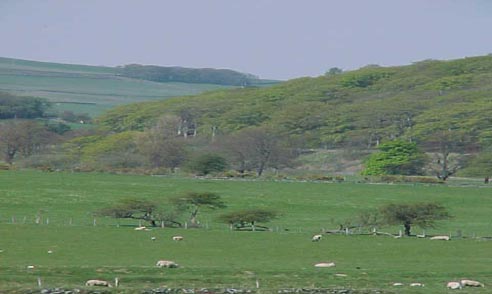
A View of the area looking North from Haughfoot towards Torsonce House just South of StowLocated in the rolling hills of the Scottish Borders, The Haughfoot Hamlet where the original Lodge was sited was approximately 1 mile south of the village of Stow. |
||||
"On December 22nd, 1702, in the little Scottish hamlet of Haughfoot, a Lodge of Masons was founded. It flourished for 61 years until 1763, and apparently disappeared into thin air." So wrote Brother Harry Carr in his History of the Lodge at Haughfoot (Trans. Ars Quatuor Coronati Lodge No 2076 (E.C.), vol. Lxiii, 1950, pp 255-303).Although nothing now remains of the Hamlet of Haughfoot,
the minute book of the Lodge still exists. It records some of the
most important events in early the history of Freemasonry. John Hoppringle of Torsonce (Laird of Torsonce) James Pringle (Torsonce's Brother) Andrew Thomson (probably a local lawyer in Galashiels)
|
||||
The First Initiates:-Sir James Scott of Gala (Laird of Gala)Thomas Scott – Gala's Brother David Murray in Philiphaugh James Pringle in Haughfoot Robert Lourie in Stowtounhead John Pringle – Wright |
||||
Why is the Haughfoot minute book considered as so important? well none of the founding members was an operative mason thus we have the first ever record in the world of a purely speculative lodge. The Haughfoot Lodge is therefore the earliest link between operative and speculative lodges but it's importance does not rest there.At the beginning of the minute book is the ‘Haughfoot Fragment’, a piece of ritual, presumably written by the first secretary and hence undoubtedly was the ritual performed by the brethren. This ritual is a series of questions and answers and it overlaps with what is known as the Edinburgh Register House MS of 1696. There is nothing in the Edinburgh Register House MS to identify it conclusively as having Masonic origins but the Haughfoot fragment provides the critical evidence to link speculative ritual to its operative origins. The Haughfoot Lodge thus occupies a uniquely important place in the history of Freemasonry and its ter-centenary was celebrated in December 2002 following the consecration of the new lodge in August 2002. Brother Harry Carr
states in his book about
the Haughfoot Lodge that it ‘apparently disappeared into thin air’ but
this is not quite true. The Lodge as a collective entity ceased, however, there is sufficient evidence to show
the remaining members continued as separate "Societies" in Galashiels and
Stow - with the remainder being integrated into the Lodge at Selkirk. Those three daughter
lodges were the three sponsor
lodges of the New Haughfoot Lodge No 1824
|
||||

This view taken from the main A7 looking North shows the area of Haughfoot - Torsonce House is just visible in the trees to the right |
||||
